


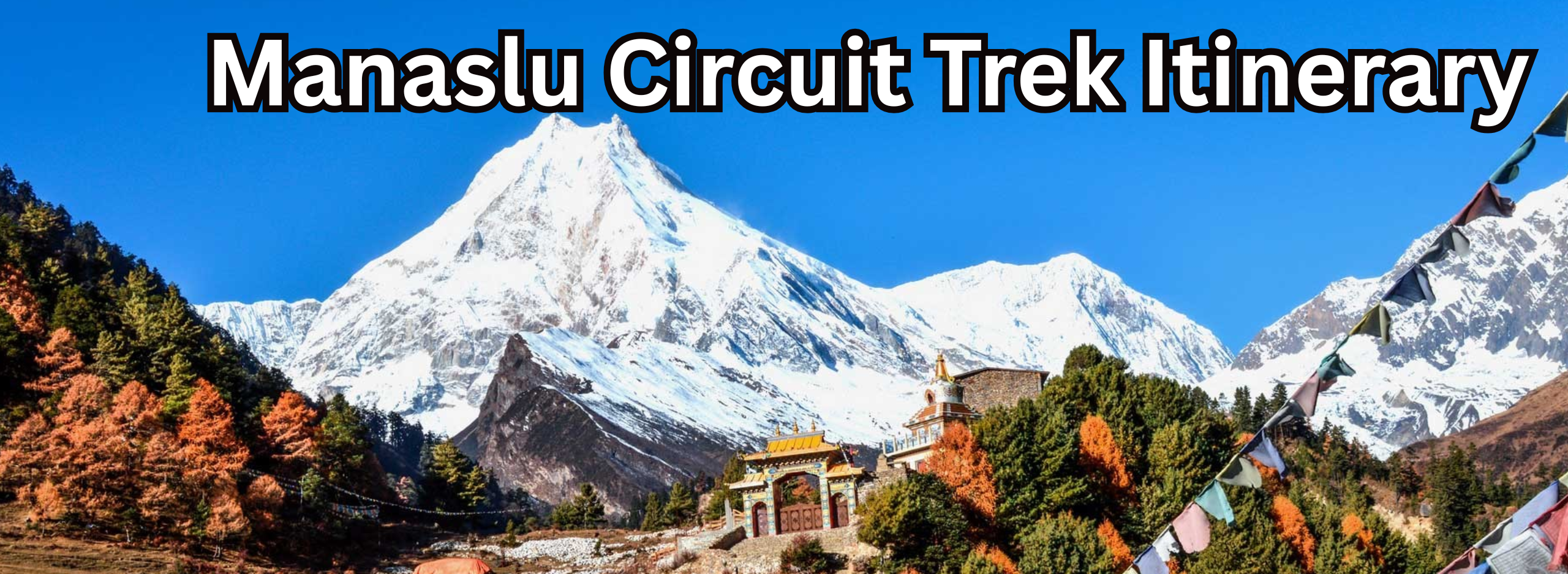
Manaslu Circuit Trek is a 15-day trekking adventure in Nepal that circles Mount Manaslu (8,163m), the eighth-highest mountain in the world. This trek is known for its stunning Himalayan views, remote trails, rich Tibetan culture, and the challenging Larkya La Pass (5,106m). It is a less-crowded alternative to popular treks like the Annapurna Circuit, making it perfect for trekkers seeking both adventure and cultural immersion. Today we will discuss about Manaslu Circuit Trek Itinerary in detail.
The Manaslu Circuit Trek is one of Nepal’s most rewarding trekking experiences. Unlike heavily trafficked routes such as Everest Base Camp or Annapurna Circuit, this trek offers a peaceful and authentic Himalayan journey.
Starting from Machha Khola and ending at Tilije, the trail passes through lush river valleys, alpine meadows, and rugged high passes. Along the way, you’ll encounter Gurung and Nubri villages influenced by Tibetan Buddhism, with colorful prayer flags, mani walls, and centuries-old monasteries.
This trek requires a Restricted Area Permit (RAP), meaning it is not open for solo trekking you must trek with a registered guide and in a group of at least two people. The 15-day itinerary is designed to allow proper acclimatization, cultural exploration, and gradual altitude gain, ensuring safety and comfort.
For adventure lovers, the highlight is crossing Larkya La Pass, one of the most beautiful mountain passes in Nepal. From the pass, you can enjoy panoramic views of Himlung Himal, Cheo Himal, Kang Guru, and Annapurna II.
Whether you are an experienced trekker or a well-prepared beginner with good fitness, this trek offers an unforgettable mix of scenery, culture, and adventure.
Manaslu Circuit Trek Overview
The Manaslu Circuit Trek is a challenging 15-day trek in Nepal that circles Mount Manaslu (8,163m), crossing the high-altitude Larkya La Pass (5,106m). It starts from Machha Khola in the Gorkha District and ends in Tilije, covering around 177 kilometers. The trek combines diverse landscapes from subtropical forests to barren alpine terrain and offers rich cultural experiences in remote Gurung and Tibetan villages. It is best done in spring (March-May) and autumn (September-November) for clear skies and stable weather.
The Manaslu Circuit Trek is often described as “Nepal’s hidden gem” because it is less crowded than other popular trekking routes but offers equally stunning mountain scenery and a deep cultural journey.
This trek is part of the Manaslu Conservation Area and requires a Restricted Area Permit (RAP), which means trekkers must go with a registered guide and a minimum of two people in a group. This restriction helps keep the region unspoiled and culturally authentic.
 14 Days
 Challenging
US$ 1290
The route follows the Budhi Gandaki River upstream, starting at low altitudes with warm, humid conditions and gradually climbing into alpine landscapes and glaciated passes. Each day, the environment changes terraced rice fields give way to rhododendron forests, which later transform into rocky, barren mountain slopes as you approach the high passes.
Culturally, the trek is fascinating. In the lower section, you’ll find predominantly Gurung communities following Hindu traditions. As you go higher, villages such as Namrung, Lho, Samagaon, and Samdo are strongly influenced by Tibetan Buddhism. You will see prayer flags fluttering in the wind, intricately carved mani stones, and ancient monasteries perched on hillsides.
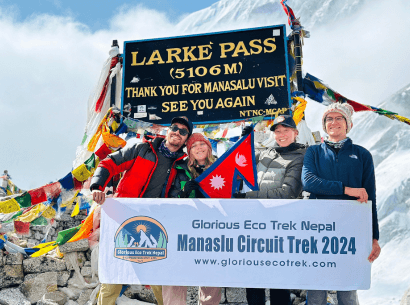
The highlight of the trek is crossing Larkya La Pass at 5,106m, one of Nepal’s most scenic and longest passes. From here, the views stretch across several mountain ranges, including Himlung Himal, Cheo Himal, Kang Guru, and Annapurna II.
Physically, this trek is demanding. Daily walking times average 6–8 hours, with steep ascents and descents, especially before and after Larkya La Pass. Trekkers should have good fitness levels and be prepared for the effects of high altitude.
Quick Facts Table
| Features | Details |
| Total Duration | 15 days |
| Max Altitude | 5,106 m (Larkya La Pass) |
| Total Distance | Approx. 177 km |
| Best Seasons | Spring (Mar–May), Autumn (Sep–Nov) |
| Difficulty | Challenging |
| Starting Point | Machha Khola |
| Ending Point | Tilije |
| Required Permits | RAP (Restricted Area Permit), MCAP (Manaslu Conservation Area Permit), ACAP (Annapurna Conservation Area Permit) |
| Accommodation | Teahouses and lodges |
| Average Walking Hours | 6–8 hrs/day |
Detailed Manaslu Circuit Trek Itinerary – 15 Days
Day 1: Arrival in Kathmandu (1,400 m / 4,593 ft)
You land at Tribhuvan International Airport in Kathmandu, where our representative from Glorious Eco Trek Nepal welcomes you and transfers you to your hotel. The rest of the day is for rest, a short walk around Thamel, and preparing for the trek.
Your Manaslu adventure begins as you touch down in Kathmandu, Nepal’s vibrant capital. If the weather is clear, you may already catch your first glimpse of the snow-capped Himalayas during your flight. After clearing customs, our representative will greet you at the airport and escort you to your hotel in Thamel, the heart of Kathmandu’s tourist district.
Once checked in, you can relax after your flight or explore the bustling streets lined with trekking gear shops, handicraft stalls, and cafes. Thamel is also a great place to buy last-minute trekking essentials. In the evening, you’ll meet your guide, go through a short briefing, and prepare for the journey ahead.
Day 2: Kathmandu Sightseeing & Trek Preparation
We explore UNESCO World Heritage Sites in Kathmandu and make final preparations for the trek.
Today is a cultural immersion before the trek begins. After breakfast, we set off to visit Kathmandu’s most famous landmarks:
- Kathmandu Durbar Square – A historic palace complex with intricate wood and stone carvings.
- Boudhanath Stupa – One of the largest Buddhist stupas in the world, surrounded by prayer wheels and monasteries.
- Swayambhunath (Monkey Temple) – Perched on a hilltop, offering panoramic views of the city.
- Pashupatinath Temple – Nepal’s most sacred Hindu temple, located by the Bagmati River.
In the afternoon, we check our trekking gear, buy any missing items, and ensure permits are ready. Evening free to relax or enjoy Kathmandu’s nightlife.
Day 3: Drive from Kathmandu to Machha Khola (900 m / 2,952 ft)
Distance: Approx. 160 km
Duration: 8–9 hrs (public bus) / 7–8 hrs (private jeep)
We leave Kathmandu early and drive through winding roads along the Trisuli and Budhi Gandaki Rivers, arriving in Machha Khola by evening.
The drive to Machha Khola offers a first taste of rural Nepal. The road winds through hillsides, rivers, and terraced fields. Small roadside towns like Arughat and Soti Khola mark the beginning of the Manaslu region. If you travel by jeep, you can make scenic stops; public buses follow a fixed schedule with a couple of breaks for lunch and tea. By late afternoon, we reach Machha Khola, a small village named after the “Fish River” that flows nearby. Overnight stay in a teahouse.
Day 4: Machha Khola to Jagat (1,340 m / 4,395 ft)
Distance: 22 km approx.
Duration: 7–8 hrs
We trek along the Budhi Gandaki River, passing Gurung villages, forests, and hot springs at Tatopani, before reaching the stone-built village of Jagat.
The trail begins gently, following the river and crossing several suspension bridges. You’ll pass Khorlabeshi, a Gurung settlement known for its warm hospitality, and then arrive at Tatopani, where trekkers can enjoy natural hot springs. The path then climbs through forests and rocky trails, eventually leading to Jagat, a village with a traditional stone gate and mani walls. Jagat is also the checkpoint where trekking permits are verified.
Day 5: Jagat to Deng (2,095 m / 6,871 ft)
Distance: 20 km approx.
Duration: 8–9 hrs
We trek through Sirdibas and Phillim, cross multiple suspension bridges, and pass rhododendron and pine forests before reaching Deng.
From Jagat, the trail gently climbs to Sirdibas, a charming Buddhist village decorated with prayer flags and chortens. We continue to Phillim, where the permit checkpoint is located, and follow the river on its western bank. The scenery becomes more dramatic, with cliffs, waterfalls, and lush forests. After crossing the Siyar Khola bridge, we reach Deng, a small settlement offering the first close views of snow-covered peaks.
Day 6: Deng to Namrung (2,900 m / 9,512 ft)
Distance: 19 km approx.
Duration: 7–8 hrs
We pass through Rana and Bihi Phedi, walk through forests of fir and oak, and arrive in the Tibetan-influenced village of Namrung.
The day begins with a climb over a suspension bridge to Rana. We pass farmlands, small waterfalls, and mani walls before entering forested trails. The scenery opens up as we approach Namrung, a picturesque village that serves as the entry point to Upper Nupri, a region heavily influenced by Tibetan culture. From here, you’ll notice traditional stone houses, carved wooden windows, and locals in traditional attire.
Day 7: Namrung to Lho Gaun (3,180 m / 10,430 ft)
Distance: 10 km approx.
Duration: 4–5 hrs
We pass Lihi and Sho villages, with views of Mt. Manaslu and Peak 29, before reaching Lho Gaun, home to a large monastery.
The short trek today allows plenty of time to enjoy the scenery. We pass Lihi, a village with fields of barley and buckwheat, and Sho, known for its gateway chortens. From here, Mt. Manaslu appears closer, dominating the skyline. Lho Gaun itself has a large monastery where over 150 monks study. Sunset views over Manaslu from here are unforgettable.
Day 8: Lho Gaun to Samagaon (3,520 m / 11,550 ft)
Distance: 8 km approx.
Duration: 4–5 hrs
We follow a gentle trail through pine and rhododendron forests, pass Shyala Village with its stunning mountain views, and reach the large settlement of Samagaon.
Detailed Explanation:
From Lho Gaun, the trek continues along a river, with occasional short climbs through mossy forests. We pass Shyala Village, surrounded by fields of potatoes and barley. Here, the views open up to Mt. Manaslu, Himalchuli, Ngadi Chuli, and other peaks.
Reaching Samagaon feels like stepping back in time — traditional stone houses, grazing yaks, and women spinning wool are common sights. The village is also a base for treks to Manaslu Base Camp and Pungyen Gompa. We rest here to prepare for higher altitudes.
Day 9: Acclimatization Day in Samagaon
We rest and acclimatize, with optional hikes to Pungyen Gompa or Manaslu Base Camp for incredible views.
Detailed Explanation:
Acclimatization is key to a safe and enjoyable trek. Today, we stay in Samagaon but keep active with light hiking:
- Pungyen Gompa (3,875m) – A Buddhist monastery offering panoramic views of Manaslu and surrounding glaciers.
- Manaslu Base Camp (4,800m) – A longer, more strenuous hike for those feeling strong.
The day also offers a chance to explore Labrang Gompa and Kargya Chholing Monastery, learning about local Tibetan Buddhist traditions. By staying active at a higher elevation during the day and sleeping lower at night, we help our bodies adjust to the altitude.
Day 10: Samagaon to Samdo (3,875 m / 12,710 ft)
Distance: 8 km approx.
Duration: 4–5 hrs
We trek slowly to Samdo, a Tibetan refugee village near the Nepal–Tibet border, passing yak pastures and mani walls.
Leaving Samagaon, the trail climbs gradually through fields and along mani walls carved with Buddhist prayers. The views of Manaslu, Samdo Peak, and surrounding snowfields are spectacular. Samdo is a small, windswept village inhabited by descendants of Tibetan traders. Here, you can witness a lifestyle that has remained largely unchanged for centuries.
Because of the high altitude, we keep the pace slow and avoid overexertion.
Day 11: Samdo to Dharmasala (4,460 m / 14,630 ft)
Distance: 6 km approx.
Duration: 4–5 hrs
We trek to Dharmasala, a simple stone guesthouse at the base of Larkya La Pass, preparing for tomorrow’s challenging crossing.
The trail starts with a gentle descent to cross the Athahra Saya Khola, then follows the Larke River. Prayer flags signal that we’re nearing the pass. Soon, we see the Larkya Glacier, a breathtaking sheet of ice surrounded by rugged peaks.
Dharmasala (also called Larkya Phedi) is basic, with dormitory-style rooms and limited facilities. The altitude is significant, so we focus on staying warm, hydrated, and well-rested for the big day ahead.
Day 12: Dharmasala to Bhimtang (3,590 m / 11,750 ft) via Larkya La Pass (5,106 m / 16,752 ft)
Distance: 14–15 km approx.
Duration: 8–9 hrs
We start early to cross the Larkya La Pass (5,106m), the highest point of the trek, and descend to the beautiful valley of Bhimtang.
This is the most challenging and rewarding day of the Manaslu Circuit Trek. We set off before sunrise, climbing gradually over a rocky moraine. The trail is steep in parts, but the views grow more dramatic with every step.
At the pass, we are rewarded with a panorama of Himlung Himal (7,126m), Cheo Himal (6,820m), Kang Guru (6,981m), and Annapurna II (7,937m). After taking photos and soaking in the moment, we descend a long, steep slope to Bhimtang, a scenic meadow surrounded by mountains.
Day 13: Bhimtang to Gho (2,515 m / 8,250 ft)
Distance: 15 km approx.
Duration: 6–7 hrs
We descend through forests and meadows, crossing rivers and passing small villages before reaching Gho.
From Bhimtang, the trail offers one last look at the mountains before dropping into lush forests of rhododendron and oak. We cross the Dudh Khola on wooden bridges and pass through terraced fields. The lower altitude brings warmer air and greener landscapes. Gho is a peaceful village with comfortable teahouses, making it a great place to rest after the demanding pass crossing.
Day 14: Gho to Tilije (2,300 m / 7,546 ft) and Drive to Kathmandu
Walking Distance: 5 km
Walking Duration: 1.5 hrs
Driving Duration: 10 hrs
We walk to Tilije, then drive to Besisahar and onward to Kathmandu, celebrating the completion of the trek.
The final morning on the trail is short and easy. We reach Tilije, where jeeps are available for the drive to Besisahar. From here, we switch to a private vehicle for the long ride back to Kathmandu.
Once in the city, we check into our hotel, enjoy a hot shower, and perhaps head out for a celebratory dinner a well-deserved reward after nearly two weeks in the Himalayas.
Day 15: Final Departure from Kathmandu
Your trek concludes, and we transfer you to the airport for your flight home.
After breakfast, our team will escort you to Tribhuvan International Airport. As you fly out, the memories of remote trails, mountain passes, and warm village hospitality will stay with you. Many trekkers leave already planning their return to explore another corner of Nepal. Total Cost for this trek is USD 1290.
Key Highlights of the Manaslu Circuit Trek
The Manaslu Circuit Trek offers some of Nepal’s most spectacular experiences — crossing the Larkya La Pass (5,106m), walking through remote villages influenced by Tibetan culture, exploring ancient monasteries, trekking beside glaciers, and enjoying panoramic views of Himalayan giants like Mount Manaslu, Himalchuli, and Annapurna II. It is a less crowded, more authentic alternative to the Annapurna and Everest treks.
The Manaslu Circuit Trek is often called a hidden gem because it delivers everything trekkers dream of high mountains, diverse landscapes, and deep cultural immersion — without the heavy crowds found on other trails. Here are the main highlights that make this trek truly special:
1. Crossing the Larkya La Pass (5,106m)
One of the highest trekking passes in Nepal, Larkya La is the most thrilling day of the trek. The climb is challenging, but the rewards are immense — a 360° panorama of snow-covered peaks, including Himlung Himal (7,126m), Cheo Himal (6,820m), Kang Guru (6,981m), and Annapurna II (7,937m).
This crossing also gives trekkers a sense of accomplishment that few experiences can match.
2. Close-up Views of Mount Manaslu (8,163m)
The trek takes you around Mount Manaslu, the world’s eighth-highest peak. Unlike Everest or Annapurna, where you often see the mountains from a distance, the Manaslu trail offers close, uninterrupted views from villages like Lho, Shyala, and Samagaon. The massive icefalls and glaciers add to the dramatic scenery.
3. Authentic Tibetan-influenced Culture
Higher sections of the trek, especially Namrung, Lho, Samagaon, and Samdo, are home to the Nubri people, whose lifestyle, traditions, and architecture are deeply influenced by Tibetan culture. You’ll see prayer flags, mani walls, chortens, and beautifully carved wooden houses. Locals still wear traditional clothing, and many speak Tibetan dialects.
4. Ancient Monasteries and Spiritual Sites
The Manaslu region is dotted with centuries-old monasteries such as:
- Pungyen Gompa – A serene monastery with stunning views of Manaslu’s glaciers.
- Lho Monastery – A large gompa housing young monks.
- Kargya Chholing Monastery – Known for colorful murals and religious ceremonies.
Visiting these sites gives a deep sense of the spiritual life in the Himalayas.
5. Diverse Landscapes in a Single Trek
This trek covers almost every type of Himalayan landscape:
- Lower region – Subtropical forests, terraced fields, waterfalls.
- Middle region – Alpine meadows, rhododendron forests, fast-flowing rivers.
- High region – Rocky passes, glaciers, and snowy peaks.
The variety keeps every day fresh and exciting.
6. Remote and Less Crowded Trails
Unlike the Everest Base Camp or Annapurna Circuit, the Manaslu Circuit sees fewer trekkers due to its restricted area status. This means peaceful trails, uncrowded teahouses, and a more intimate connection with nature and local culture.
7. Wildlife and Natural Beauty in Manaslu Conservation Area
The trail passes through the Manaslu Conservation Area, home to:
- Himalayan tahr
- Snow leopards (rarely seen)
- Musk deer
- Himalayan monal (Nepal’s national bird)
Spring brings blooming rhododendrons, while autumn offers crystal-clear mountain views.
8. Cultural Interaction with Local Communities
From Gurung villages in the lower valleys to Tibetan refugee communities in the higher regions, trekkers have the chance to share stories, enjoy local meals, and witness traditional lifestyles that have remained unchanged for generations.
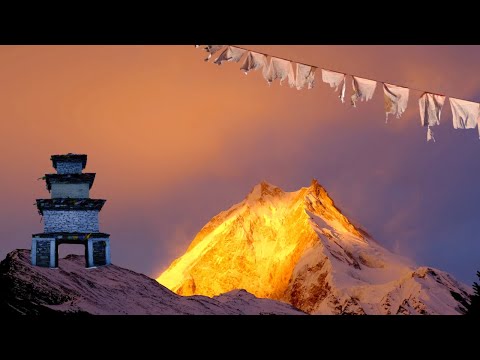
Video Credit: Nicholas Eager
Altitude Profile & Acclimatization
Altitude is one of the most important factors to consider on the Manaslu Circuit Trek. The body needs time to adapt to lower oxygen levels at higher elevations, and the risk of Acute Mountain Sickness increases above 2,500 meters.
The Manaslu Circuit itinerary is planned to follow the golden rule of trekking in the Himalayas:
“Climb high, sleep low, and don’t increase your sleeping altitude by more than 300–500 meters per day once above 3,000 meters.”
This is why acclimatization days in Samagaon and Samdo are built into the schedule. They allow trekkers to explore higher points during the day and return to sleep at a lower altitude — the most effective way to adapt.
Manaslu Circuit Trek – Altitude Profile
| Day | Location | Altitude (m) | Altitude (ft) |
| 1 | Kathmandu | 1,400 m | 4,593 ft |
| 2 | Kathmandu (Sightseeing) | 1,400 m | 4,593 ft |
| 3 | Machha Khola | 900 m | 2,952 ft |
| 4 | Jagat | 1,340 m | 4,396 ft |
| 5 | Deng | 2,095 m | 6,873 ft |
| 6 | Namrung | 2,900 m | 9,514 ft |
| 7 | Lho Gaun | 3,180 m | 10,433 ft |
| 8 | Samagaon | 3,520 m | 11,549 ft |
| 9 | Samagaon (Acclimatization) | 3,520 m | 11,549 ft |
| 10 | Samdo | 3,875 m | 12,713 ft |
| 11 | Dharmasala | 4,460 m | 14,633 ft |
| 12 | Larkya La Pass / Bhimtang | 5,106 m (Pass) / 3,590 m (Bhimtang) | 16,752 ft / 11,778 ft |
| 13 | Gho | 2,515 m | 8,251 ft |
| 14 | Tilije / Kathmandu | 2,300 m | 7,546 ft |
| 15 | Departure | — | — |
Why Acclimatization is Important
At high altitudes, oxygen levels are significantly lower. For example:
- At sea level, oxygen saturation is around 21%.
- At 5,000 meters, oxygen saturation drops to around 11%.
Without proper adaptation, trekkers may experience:
- Mild AMS – headache, nausea, loss of appetite.
- Severe AMS – High-Altitude Pulmonary Edema (HAPE) or High-Altitude Cerebral Edema (HACE), which can be life-threatening.
Acclimatization Days in the Itinerary
- Day 9: Samagaon (3,520m) – Optional hikes to Pungyen Gompa (3,875m) or Manaslu Base Camp (4,800m).
- Day 10: Samdo (3,875m) – Easy exploration to nearby viewpoints or the Nepal–Tibet border trail.
Both days follow the “climb high, sleep low” principle, which is proven to improve oxygen efficiency in the body.
Best Time to Do the Manaslu Circuit Trek
The best time for the Manaslu Circuit Trek is during spring (March to May) and autumn (September to November). These seasons offer the clearest mountain views, stable weather, and comfortable temperatures. Winter (December to February) is possible for experienced trekkers but involves snow and very cold conditions, while the monsoon season (June to August) brings heavy rain, leeches, and landslides, making it less favorable.
Choosing the right time for the Manaslu Circuit Trek can make the difference between an unforgettable adventure and a difficult journey. This trek covers a wide range of elevations — from 900m in Machha Khola to 5,106m at Larkya La Pass — which means the climate varies greatly depending on altitude and season.
The two most popular trekking windows — spring and autumn — align with Nepal’s dry seasons, providing stable weather and the best conditions for high mountain crossings like Larkya La Pass.
Seasonal Breakdown
1. Spring Season (March – May)
- Weather: Mild temperatures, clear skies in the mornings, some clouds in the afternoons.
- Temperature: 10°C to 20°C in lower regions; -6°C to 5°C at higher elevations.
- Highlights: Blooming rhododendrons, lush greenery, longer daylight hours.
- Best For: Nature lovers, photographers, first-time trekkers.
- Things to Know: Trails are moderately busy; late May may see some pre-monsoon haze.
2. Autumn Season (September – November)
- Weather: Clear, crisp skies, stable weather, minimal rainfall.
- Temperature: 12°C to 22°C in lower regions; -5°C to 6°C at higher elevations.
- Highlights: Crystal-clear mountain views, harvest season festivals (Dashain, Tihar, Mani Rimdu).
- Best For: Photographers, cultural trekkers, those prioritizing visibility.
- Things to Know: This is the peak trekking season, so book teahouses in advance.
3. Winter Season (December – February)
- Weather: Cold, especially above 3,500m; snow common at Larkya La Pass.
- Temperature: -10°C to 5°C at high altitudes.
- Highlights: Quiet trails, pristine snow landscapes.
- Best For: Experienced trekkers with proper winter gear.
- Things to Know: Some high passes may be closed due to heavy snow.
4. Monsoon Season (June – August)
- Weather: Heavy rain in lower regions, cloudy skies, humid conditions.
- Temperature: 18°C to 28°C in lower regions; 0°C to 10°C at higher altitudes.
- Highlights: Lush landscapes, fewer trekkers.
- Best For: Trekking enthusiasts wanting solitude and don’t mind wet conditions.
- Things to Know: Risk of leeches, landslides, and slippery trails.
Month-by-Month Weather & Trekking Conditions
| Month | Weather | Trail Condition | Views | Crowd Level |
| Jan | Very cold, snow possible | Snow in high passes | Clear but very cold | Very low |
| Feb | Cold, dry | Some snow | Clear skies | Low |
| Mar | Mild, dry | Excellent | Rhododendrons bloom | Moderate |
| Apr | Mild, clear mornings | Best condition | Great visibility | High |
| May | Warm, some haze | Good | Flowers in bloom | High |
| Jun | Rain starts | Slippery | Limited views | Low |
| Jul | Heavy rain | Muddy, leeches | Poor visibility | Very low |
| Aug | Monsoon easing | Wet trails | Better visibility late month | Low |
| Sep | Clear skies, stable | Excellent | Best views | High |
| Oct | Stable, dry | Perfect | Stunning views | Very high |
| Nov | Crisp, cold nights | Great | Crystal clear | High |
| Dec | Cold, possible snow | Snow possible | Clear but cold | Low |
Travel Tips for the Manaslu Circuit Trek
Bring the right permits (RAP, MCAP, ACAP) through a licensed agency, trek with a registered guide, follow a slow acclimatization plan, carry cash (no ATMs on the trail), purify all drinking water, pack warm layers (down jacket, -10°C sleeping bag), and get travel insurance that covers helicopter evacuation above 5,000 m. Use a jeep to Machha Khola and expect simple teahouses with paid hot showers, paid charging, and spotty Wi-Fi. Respect local culture, pack out your waste, and cap your day-pack at 6–8 kg.
Altitude, Health & Safety
Follow “climb high, sleep low,” hydrate 3–4 L/day, avoid alcohol, and descend if AMS symptoms worsen.
- Acclimatization Days: Samagaon and Samdo. Do short higher hikes; sleep lower.
- AMS Signs: Headache, nausea, dizziness, poor sleep, loss of appetite.
- If Symptoms Worsen: Stop ascending; descend and rest.
- Medicines: Some trekkers use acetazolamide (Diamox)—speak to your doctor first.
- Sun & Cold: Sunscreen (SPF 50), lip balm, sunglasses; warm layers to prevent hypothermia.
- First-Aid Kit: Blister care, bandages, pain relief, ORS salts, personal meds.
Packing List Essentials (Light & Warm)
Pack layers, a -10°C to -15°C sleeping bag, waterproof shell, sturdy boots, and water treatment.
Core kit:
- Footwear: Broken-in trekking boots, liner + trekking socks, camp shoes.
- Clothing Layers:
- Base: 2–3 moisture-wicking tops, thermal top/bottom.
- Mid: Fleece or light insulated jacket.
- Warmth: Down jacket.
- Shell: Waterproof jacket & pants.
- Hands/Head: Warm gloves, beanie, sun hat, Buff.
- Sleep: Sleeping bag comfort -10°C (colder in winter), sleeping bag liner.
- Gear: Trekking poles, headlamp, power bank (10k–20k mAh), universal adapter, quick-dry towel.
- Water: 2 bottles (or bladder) + filter/UV or chlorine dioxide tablets.
- Toiletries: Wet wipes, hand sanitizer, biodegradable soap, sunscreen, lip balm.
- Optional (seasonal): Microspikes (winter), gaiters (mud/snow), lightweight crampons (if advised by guide).
Money, Connectivity & Power
Carry enough cash (NPR) for the whole trek; Wi-Fi and power are paid and unreliable; bring a power bank and a local SIM.
- Cash: Withdraw in Kathmandu. No reliable ATMs after the trail starts.
- Costs on Trail: Hot showers, device charging, and Wi-Fi often cost extra; prices rise with altitude.
- SIM: Buy NTC or Ncell in Kathmandu; coverage is patchy beyond Jagat.
- Charging: Teahouses may have limited sockets. Charge during meals, carry a power bank.
- Wi-Fi: Available in some villages; expect slow speeds or outages.
Accommodation & Food (Teahouse Basics)
You’ll stay in simple teahouses with twin rooms; food is basic, hot, and filling—think dal bhat, noodles, soups, and momos.
- Rooms: Twin beds, foam mattress, pillow; bring a sleeping bag.
- Bathrooms: Shared; squat/Western mix. Hot showers are paid and may be bucket showers.
- Meals: Dal bhat (unlimited refills), thukpa, chowmein, fried rice, omelets, porridge.
- Water: Buy boiled water or purify tap water yourself.
- Food Safety: Avoid meat high on the trail; go vegetarian above Jagat.
Getting There & Back (Transport)
Take a jeep (faster, flexible) or public bus (cheaper) from Kathmandu → Machha Khola; return Tilije → Besisahar → Kathmandu.
- Outbound: Early morning jeep via Arughat/Soti Khola to Machha Khola.
- Return: Short walk to Tilije, then local jeep to Besisahar, onward private vehicle to Kathmandu.
- Road Reality: Mountain roads can be bumpy; landfalls or delays in monsoon.
Why Choose Glorious Eco Trek Nepal for the Manaslu Circuit Trek
Choosing the right trekking company can make all the difference in your Manaslu Circuit experience. At Glorious Eco Trek Nepal, we combine deep local knowledge, experienced guides, and personal care to ensure every step of your journey is safe, comfortable, and unforgettable.
Our guides are Manaslu specialists, born and raised in the region or with years of trekking experience here. This means you get more than just a trail leader you get a cultural bridge to the people, history, and traditions of the Manaslu region.
We handle everything for you, from obtaining the Restricted Area Permit to arranging transport, teahouse accommodations, and meals. Our itineraries are carefully designed for proper acclimatization, so you can trek at a safe pace and enjoy the altitude without rushing.
We believe in small group sizes—this allows for a more personal experience, more flexibility, and better support on the trail. Every trek is led by a licensed, English-speaking guide, supported by friendly local porters who carry your luggage with care.
Safety is our top priority. All our guides are trained in first aid and altitude sickness management. We monitor weather, trail conditions, and your health daily. In case of emergencies, we assist with helicopter evacuation and coordinate directly with your travel insurance provider.
We also believe in responsible trekking. Glorious Eco Trek Nepal supports local communities by using family-run teahouses, sourcing food locally, and respecting the fragile mountain environment. When you trek with us, you’re also helping preserve the culture and nature of Manaslu for future generations.
Whether you’re an experienced hiker or it’s your first trek in Nepal, our team will make you feel supported from the moment you land in Kathmandu to the day you depart. With GET, you’re not just booking a trek—you’re joining a community of adventurers who care deeply about the mountains, the people, and your journey.
Your adventure. Your safety. Your memories. That’s the Glorious Eco Trek Nepal promise.