

Everest Base Camp Trek via Gokyo Lakes – 17 Days
Based on 380 reviews

Duration
17 Days
Trip Difficulty
Challenging
Max Altitude:
5,555m. / 18,225ft.
Group Size
2-30
Best Season
Feb, Mar, Apri, May, June, Sep, Oct, Nov & Dec
Meals
Breakfast, Lunch and Dinner
Accommodation
Hotel/Lodge/ Tea House during the trek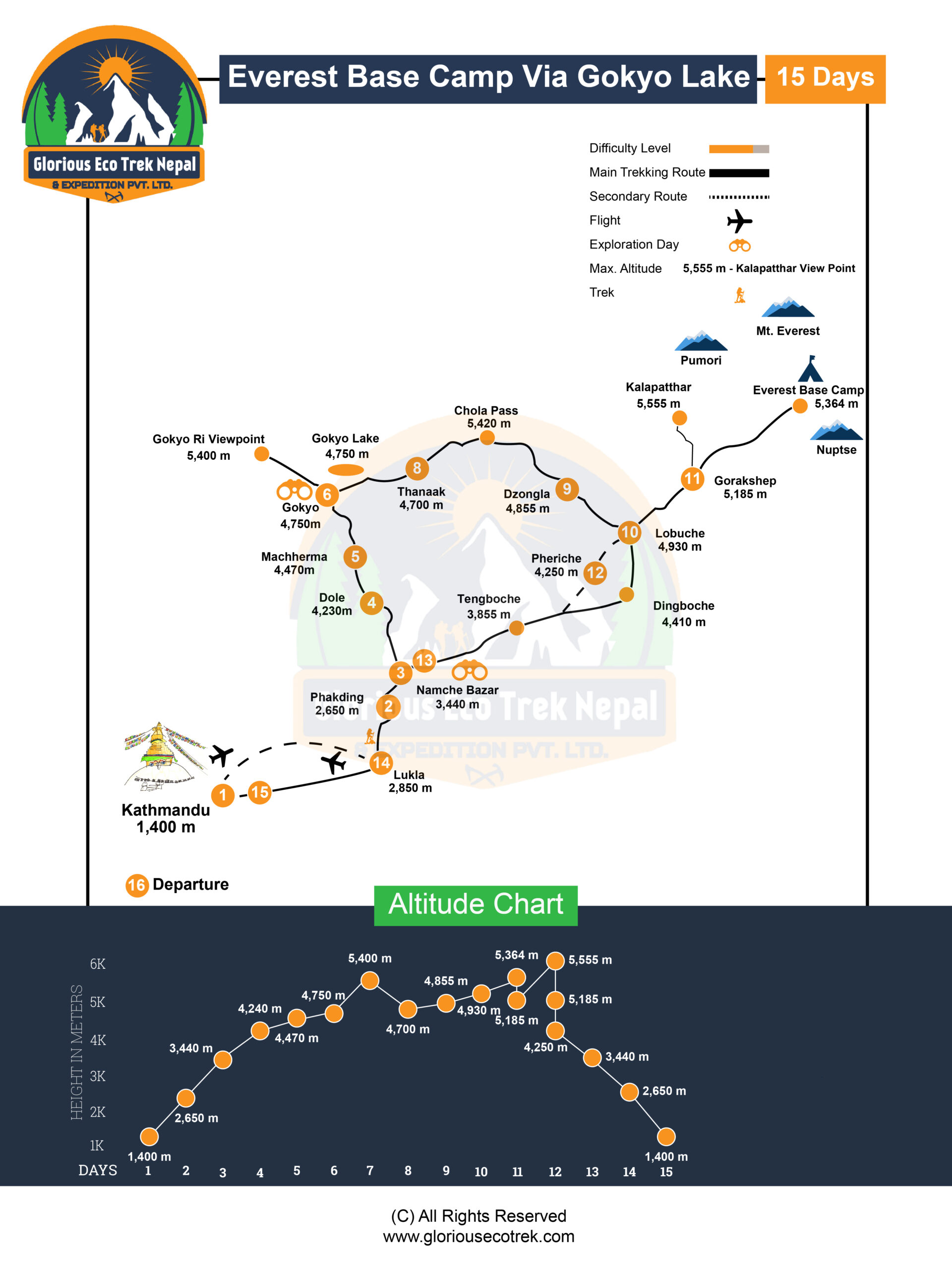
Everest Base Camp Trek via Gokyo Lakes – 17 Days route map
- Best price guarantee
- Secure & easy online booking
- Flexible booking dates

Need Help?
Talk to travel expert
 Excellent
Overview and Highlights of Everest Base Camp Trek via Gokyo Lakes – 17 Days
Everest Base Camp Trek via Gokyo Lakes is a thrilling 17-day journey that combines the iconic EBC route with the serene beauty of the Gokyo Valley and its emerald lakes. This adventurous circuit takes you through diverse landscapes, from alpine meadows and glacial valleys to ancient Sherpa villages and sacred Buddhist monasteries—all set against the breathtaking backdrop of the world’s tallest peaks.
Your adventure begins with a scenic flight to Lukla, followed by a trek through Phakding and the bustling mountain town of Namche Bazaar. As you gain altitude, the route diverges towards the Gokyo Valley, where you’ll witness the majestic Gokyo Lakes and hike up to Gokyo Ri (5,400m) for panoramic views of four 8,000-meter giants, Everest, Lhotse, Makalu, and Cho Oyu.
Crossing the dramatic Cho La Pass (5,420m), you rejoin the classic Everest trail, trekking to Everest Base Camp (5,364m) and the famous Kala Patthar viewpoint (5,555m) for one of the best sunrise views of Mount Everest. The return journey passes through Pheriche and Namche, concluding in Lukla with a return flight to Kathmandu.
This trek is ideal for experienced trekkers seeking a more challenging and scenic route to Everest Base Camp. With well-paced acclimatization days, rewarding high-altitude passes, and lesser-trodden trails, the EBC via Gokyo Lakes trek offers both natural beauty and cultural immersion at its finest.
Trip Highlights
-
Fly from Kathmandu to Lukla with stunning Himalayan views.
-
Explore Namche Bazaar, the heart of Sherpa culture.
-
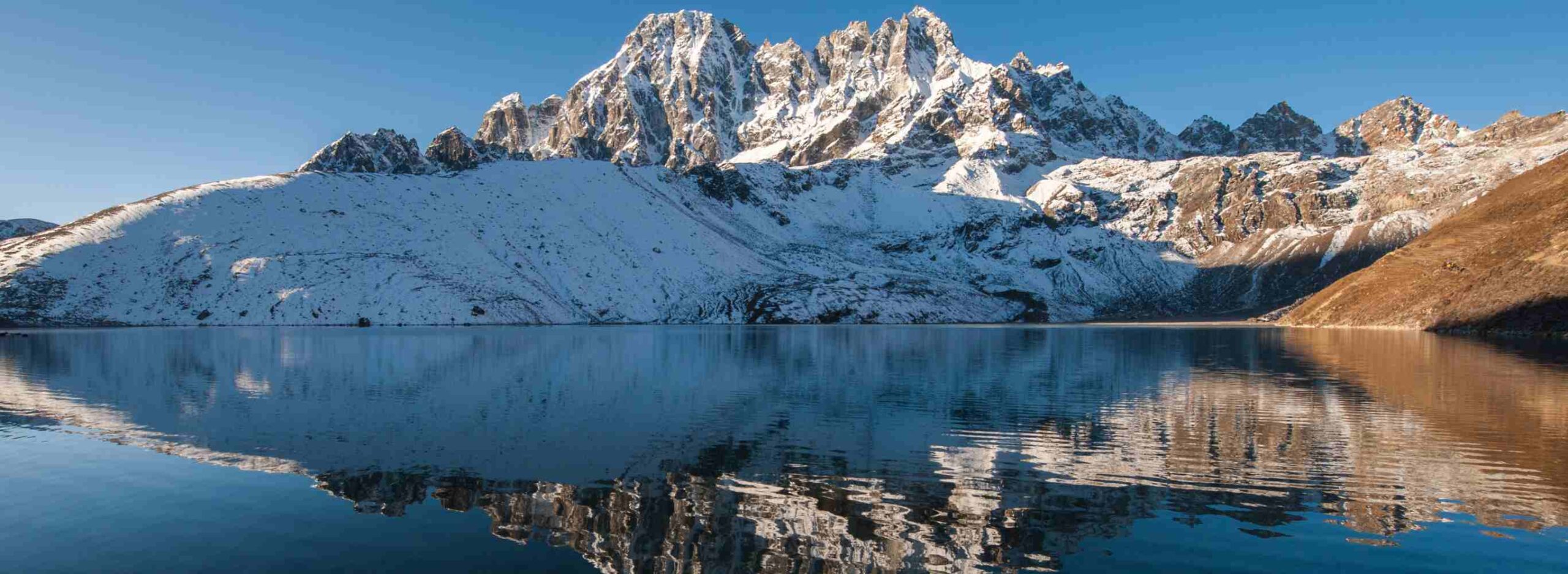
Trek through the peaceful Gokyo Valley and visit its turquoise lakes.
-
Climb Gokyo Ri (5,400 m) for panoramic views of Everest, Lhotse, Makalu, and Cho Oyu.
-
Cross the adventurous Cho La Pass (5,420 m) with incredible mountain scenery.
-
Reach Everest Base Camp (5,364 m) and stand below the world’s highest peak.
-
Hike to Kala Patthar (5,555 m) for a breathtaking sunrise over Everest.
-
Walk beside the vast Ngozumpa Glacier, the longest in Nepal.
-
Experience Sherpa traditions, monasteries, and colorful prayer flags.
-
Enjoy a well-paced trek with acclimatization days in Namche and Gokyo.
Itinerary Overview of Everest Base Camp Trek via Gokyo Lakes – 17 Days
This 17-day trek to Everest Base Camp via Gokyo Lakes is a perfect combination of natural beauty, cultural experience, and thrilling adventure. Your journey begins with your arrival in Kathmandu, where you’ll have time to explore the vibrant streets and prepare for the trek. The next day, you’ll take a short and scenic flight to Lukla, the starting point of your trek.
From Lukla, you’ll trek to Phakding and then continue to the famous Sherpa town of Namche Bazaar. Here, you’ll spend an extra day to rest and acclimatize, which helps your body adjust to the increasing altitude. After Namche, instead of heading straight to Everest Base Camp, you’ll take the more scenic and peaceful Gokyo Valley route.
As you trek through Dole and Machhermo, you’ll reach the beautiful Gokyo Lakes, a series of clear, high-altitude lakes surrounded by snow-capped peaks. You’ll also hike to Gokyo Ri, one of the best viewpoints in the Everest region, where you’ll see Mt. Everest and other towering mountains like Cho Oyu, Lhotse, and Makalu.
After enjoying Gokyo, the trek continues over the high mountain pass of Cho La, which adds an adventurous element to your journey. Once you cross the pass, you’ll join the classic Everest trail and continue on to Lobuche and Gorak Shep. From there, you’ll make the exciting hike to Everest Base Camp the highlight of the trek.
The next morning, you’ll climb to Kala Patthar for an unforgettable sunrise view over Mt. Everest, then start your descent. On the way back, you’ll pass through Pheriche and Namche Bazaar before ending the trek in Lukla. Finally, you’ll fly back to Kathmandu to conclude your memorable journey.
This itinerary is carefully designed with enough acclimatization days, scenic routes, and cultural insights to make your trek to Everest Base Camp via Gokyo Lakes both safe and deeply rewarding.
Everest Base Camp Trek via Gokyo Lakes – 17 Days Itinerary

Day 01: Arrival in Kathmandu (1,350m/4,428ft), Tribhuvan International Airport
Our airport agent will be waiting for you at the Tribhuvan International Airport. He will welcome and transport you to the hotel. You can finish the check-in formalities, freshen up, and settle into your hotel room.
You can explore the streets if you want to. There are popular local markets, such as Ason and Thamel, which offer you local Nepalese products such as showpieces, hemp bags, and made products at reasonable prices.
Exploring these markets is quite a treat to your eyes. You will also get stalls of spicy street foods in Ason. You can explore some other shops offering clothes and gifts.
You will enjoy the traditional Nepali welcome dinner with our team. Our team helps or assists you and makes you informed about the trek and schedules..

Max. Altitude: 1,350m/4,429ft. ()

Meal: Breakfast
Day 02: Flight from Kathmandu (1,400m / 4,593ft) to Lukla (2,850m / 9,350ft) and Trek to Phakding (2650m / 8562ft)
The trek to Everest Base Camp via Gokyo Lakes begins with an adventurous flight to Lukla. You can capture the most amazing aerial view from the flight. After we land on Lukla, you can see the porters and other team members waiting for you. From Lukla, we will start our trek and head to Phakding. It is a short trek of 3 hours.
We will pass through Chaurikharka Village and trek down to Dudh Koshi River. From here, we will walk for a few minutes and reach Phakding. Here, you can visit nearby monasteries and rest for the night.

Activity: 3 hours
Max. Altitude: 2,850m/9,350ft. ()
Meal: Breakfast, Lunch, Dinner
Day 03: Trek from Phakding (2,650m /8,562ft) to Namche Bazaar (3,440m / 11,285ft)
We will have an early morning breakfast and continue the trek to Namche Bazaar. The trail goes along the Dudh Koshi River bank. Passing from here, we will reach to the panoramic view of snow-capped mountains. We will be crossing many long and short suspension bridges over rivers, which also include the Hillary Suspension Bridge.
Then, we will register our permits and tickets at Sagarmatha National Park. From here, we will climb up to a forest from where you will be able to spot the view of Mt. Everest. Then a few minutes of trek will take you to Namche Bazaar. Overnight stay in a hotel in Namche.
Activity: 6 hours
Max. Altitude: 3,440m/11,286ft. ()
Meal: Breakfast, Lunch, Dinner
Day 04: Rest day and acclimatization at Namche Bazaar
We will take a day in Namche so that we can explore the area and give our bodies a rest before heavy treks. We will begin the day with an early morning hike to Everest View Hotel, which serves the food with an excellent view of Mt. Everest.
Then, we will descend the trail and explore Namche Bazaar. We will begin to explore the area by visiting various Buddhist monasteries.
Then, we will visit the yak farms and Hillary School and get to know the local lifestyle of the Sherpas. Since Namche Bazaar is the main trading area of the region, you can find all kinds of facilities and items here. You can enjoy your evening in the restaurants and cafes. Overnight stay in Namche.
Max. Altitude: 3,440m/11,286ft. ()
Meal: Breakfast, Lunch, Dinner
Day 05: Trek from Namche (3,440m / 11,285ft) to Dole (4,200m / 13,270ft)
After having breakfast, we will continue our trek to Dole. This is the path-breaking point where we will turn to Dole instead of Tengboche. Here, the route is quite rough and rocky. We will cross through many ups and downs and reach Mong La Pass (3957m). The pass offers you a great view of Mt. Khumbila and Ama Dablam.
The trail goes downhill from here and passes through rhododendrons and pine forests. After crossing the forest, we will reach Phortse Tenga. Continuing the trek from here will take us to Dole. Overnight stay in Dole.
Activity: 5 hour
Max. Altitude: 4,200m/13,780ft. ()
Meal: Breakfast, Lunch, Dinner
Day 06: Trek from Dole (4,200m / 13,270ft) to Machhermo (4,470m / 14,450ft)
Leaving Dole, the trail continues to Machhermo. We will climb to the higher altitudes, providing us with even mesmerizing views. You can spot the yak pastures and meadows. This place is even more beautiful in summer. As we ascend, we get to see the panoramic view of Mt. Cho Oyu. We will reach Lapahrma village. As we hike deeper into the valley, we get to see more Himalayan views.
The trail reaches Luja village. Continuing the trek from here, we will reach Machhermo. Overnight stay in Machhermo.
Activity: 6 hours
Max. Altitude: 4,470m/14,665ft. ()
Meal: Breakfast, Lunch, Dinner
Day 07: Trek from Machhermo (4,470m / 14,450ft) to Gokyo (4,790m / 15,584ft)
After having breakfast, we will be heading towards one of the rewarding parts of the trek – Gokyo. We have a short trek to complete. The trek continues an hour before reaching the grazing lands. After crossing the grazing lands, we will come to Phanga. From here, we will walk down the narrow path and reach Gokyo.
Here, you will start to see the outlets of Gokyo Lakes. We can explore the nearby lakes as we have got plenty of time after this short trek. Overnight stay in Gokyo.
Activity: 4 hours
Max. Altitude: 4,790m/15,715ft. ()
Meal: Breakfast, Lunch, Dinner
Day 08: Rest day to acclimatize at Gokyo. Gokyo Ri viewpoint (5,400m / 17,814ft)
We are obviously going to take a day to acclimatize in this beautiful place. We will fully explore the Gokyo Valley. We will start by hiking to one of the popular viewpoints of the region – Gokyo Ri. The Gokyo Ri viewpoint offers you the top 4 highest mountains of Nepal; Everest, Makalu, Lhotse, and Cho Oyu. After enjoying the exotic view, we will descend and visit the Gokyo Lake.
The Gokyo Lake is one of the most beautiful and clear lakes in Nepal. Staying around the lake gives you a magical feel. You can see photos and videos around the lake. After exploring the remaining places, we will return back to the tea house for the night.
Activity: 2 hours
Max. Altitude: 5,400m/17,717ft. ()
Meal: Breakfast, Lunch, Dinner
Day 09: Trek from Gokyo (4,790m / 15,584ft) to Thangnak (4,700m / 15,400ft)
Leaving Gokyo, we will continue our journey towards Thagnak. Today the paths are full of ups and downs, which might be a challenge for you. But since we are not gaining the altitude, we can be crossing it properly. We will pass by Ngozumpa Glacier. After 5 hours of trek, we will reach Thagnak village.
This is a beautiful village lying on the side of Ngozumpa Glacier. Overnight stay in Thagnak village.
Activity: 5 hours
Max. Altitude: 4,790m/15,715ft. ()
Meal: Breakfast, Lunch, Dinner
Day 10: Trek from Thangnak (4,700m / 15,400ft) to Dzongla (4,855m / 15,930ft) via Cho La Pass (5420m / 17,783ft)
After having breakfast, we will continue our trek towards Dzongla. Since we have a long trek to complete, we will begin it early in the morning. The trail goes through rocky paths. Crossing the glacial moraines, we will hike to the Cho La Pass. The Cho La Pass provides you with mesmerizing views of Mt. Cholatse and the lake of Cho La.
From here, we will trek downhill which gives you a magnificent view. Finally, we will reach Dzongla after a long day trek. We will spend our night in Dzongla.
Activity: 7 hours
Max. Altitude: 5,420m/17,782ft. ()
Meal: Breakfast, Lunch, Dinner
Day 11: Trek from Dzongla (4,855m / 15,930ft) to Lobuche (4,910m / 16,175ft)
Today, we have a short hike to complete. Leaving Dzongla, we will head towards Louche. As we get closer to Lobuche, we start to get a closer view of Everest. The trail descends to Cho La Lake following the moraine. Our path follows the Khumbu Glacier. The Lobuche gets our track to the classic route of Everest. You can see the memorials of the climbers who died during the Everest climb.
Our route passes through Imja Khola. Finally, after a beautiful trek, we will reach Lobuche, which brings us close to Everest. Overnight stay in Lobuche.
Activity: 4 hours
Max. Altitude: 4,910m/16,109ft. ()
Meal: Breakfast, Lunch, Dinner
Day 12: Trek from Lobuche (4,930m / 16,175ft) to Everest Base Camp (5,364m / 17,598ft) and back to Gorak Shep (5,185m / 17,010ft)
Here is another exciting part of the trek where you will get to stand at the base camp of the highest peak of the world. Getting to a higher altitude is definitely going to be challenging. We will start the trek by heading to Gorak Shep. From Gorak Shep, we have to gather the strength and hike to the Everest Base Camp. Finally, we will reach Everest Base Camp.
The base camp gives you the most spectacular views. You will get to see the closest view of Mt. Everest. Along with that, you can see the Khumbu glacier from here. You can take a few pictures and videos to hold Everest memories. Here you can see the climbers who are all set to climb Everest. Then, we will descend back to Gorak Shep for the night.
Activity: 7 to 8 hours
Max. Altitude: 5,364m/17,598ft. ()
Meal: Breakfast, Lunch, Dinner
Day 13: Hike to Kala Patthar (5,555m / 18,208ft) viewpoint, trek to Gorak Shep and then to Pheriche (4,250m / 13,945ft)
We will go for an early morning hike to Kala Patthar for the magical sunrise view. From Kalapatthar, you can get the most pleasing sunrise over Mt. Everest. The view will definitely be remarkable. You can never forget this most beautiful moment. After enjoying the sunrise views, we will descend back to Kala Patthar for breakfast.
After having breakfast, we will rest for a few minutes and descend back to Gorak Shep following the previous route. From Gorak Shep, our trek heads to Pheriche. Overnight stay in Pheriche.
Activity: 5 hours
Meal: Breakfast, Lunch, Dinner
Day 14: Trek from Pheriche (4,250m / 13,945ft) to Namche Bazaar (3,440m / 11,285ft)
Leaving the beautiful Himalayas behind us, we will descend our trek to Namche. It will be our farewell to Mt. Everest. We will continue the trek after a warm breakfast. The trail passes through the forests having various wildlife animals. Passing through various chortens and prayer flags, we will reach Namche Bazaar.
You can rest in Namche and enjoy food and drink in nearby restaurants and bars. Overnight stay in Namche.
Activity: 6 hours
Max. Altitude: 4,250m/13,944ft. ()
Meal: Breakfast, Lunch, Dinner
Day 15: Trek from Namche Bazaar (3,440m / 11,285ft) to Lukla (2,850m / 9,350ft)
Today is the last day of our Everest Base Camp via Gokyo Lakes Trek. After finishing the breakfast, we will head towards Lukla. The trail goes down steeply and crosses various suspension bridges. Our trail also crosses various tiny villages. We will be passing along the Dudh Koshi Valley. Finally, after 6 to 7 hours of trek, we will reach Lukla.
It will be your last stay in the Khumbu region. Overnight stay in Lukla.
Activity: 7 hours
Max. Altitude: 3,440m/11,286ft. ()
Meal: Breakfast, Lunch, Dinner
Day 16: Fly back to Kathmandu (1,400m / 4,593ft) from Lukla (2,850m / 9,350ft)
Saying bye to the Khumbu region, we will go to the airport and take our flight back to Kathmandu. Within this 25-minute flight, you will have a thrilling experience with an astonishing view of the entire region. After landing in Kathmandu, we will drive you to the hotel. Finally, you can peacefully rest after this long journey.
Overnight stay in the hotel in Kathmandu.
Max. Altitude: 2,849m/9,347ft. ()
Meal: Breakfast
Day 17: Final Departure
Today is the last day. Our representative will transport you to the airport for your flight. You will always remember the overwhelming pride you felt while trekking to the Everest region. Then we bid you farewell, hoping to meet and serve you again in the future.

Note:
If you have a private group and prefer a personalized experience, we can organize a custom trip tailored to your requirements and group size, running it any day you choose.
 Price Includes
 Price Includes
 Price Excludes
 Price Excludes
What's included?

Transportation
-
Flight tickets from Kathmandu-Lukla-Kathmandu, including airport departure taxes.
-
Airport pick-up and drop-off in a private vehicle (Arrival and Departure).
-
All ground transportation, including airport transfers.

Meals
- All meals (breakfast, lunch, dinner with tea/coffee) during the trek.

Accommodation
-
Two nights at a 3-star hotel in Kathmandu with breakfast.
-
Tea house accommodations with the best twin-sharing room during the trek.

Guide and Porter
-
Friendly, professional, and experienced English-speaking guide.
-
One porter for every two trekkers.
-
Food, accommodation, salary, equipment, medicines, and insurance for trekking staff.

Trek permit and expenses
-
All necessary permits and entrance fees for trekking.
-
TIMS Fee – Tourist Information Management System.

Medical Assistance
- A medical kit carried by the trekking guide/leader.
What's not included?

International Flight
- International airfare

Accommodation
- Lunch and dinner in Kathmandu

Food
- (Covered under accommodation: lunch and dinner in Kathmandu)

Guide and Porter
- Gratitude tips for drivers, porter, and guide (given voluntarily)

Travel Insurance
- Travel insurance

Personal Expenses
-
Personal expenses such as water, shopping, snacks, bottled water, cold drinks, hot showers, alcohol, Wi-Fi, etc. during the trek
-
Personal trekking equipment
Route Map & Altitude Chart
 Packing list for Everest Base Camp Trek via Gokyo Lakes – 17 Days
 Packing list for Everest Base Camp Trek via Gokyo Lakes – 17 Days
 Packing for the 17-day Everest Base Camp Trek via Gokyo Lakes requires versatile gear for varying terrains and weather. A well-planned list ensures comfort and readiness for this unforgettable adventure.

For Head
-
Warm hat or beanie
-
Sun hat or cap
-
Buff or neck gaiter

For Upper Body
-
Thermal base layers (tops)
-
Long-sleeved trekking shirts
-
Fleece jacket or sweater
-
Insulated down jacket
-
Waterproof and windproof jacket

For Hands
-
Lightweight gloves
-
Insulated gloves or mittens

For Lower Body
-
Trekking pants
-
Thermal base layers (bottoms)
-
Waterproof and windproof pants
-
Trekking shorts (optional)

For Footwear
-
Trekking boots
-
Hiking socks (wool or synthetic)
-
Gaiters
-
Camp shoes or sandals

Toiletries
-
Personal toiletries and medications
-
Sunscreen and lip balm with SPF
-
Hand sanitizer

Accessories
-
rekking poles
-
Headlamp with extra batteries
-
Water bottle or hydration bladder
-
Water purification tablets or filter
-
Snacks and energy bars
-
Trekking towel
-
Travel adapter and charger for electronic devices
-
Trekking map and guidebook
-
Cash (Nepalese rupees) for purchases along the trail

Extra Items
-
Sleeping bag (cold-weather rating)
-
Liner for sleeping bag (optional, but increases warmth and cleanliness)
-
Mattress or sleeping pad (optional, but enhances comfort)
-
First-aid kit
-
Trekking permit and TIMS card
-
Passport and other required travel documents
-
Information on travel insurance
-
Extra memory cards/batteries and a camera
-
Portable power bank for charging electronic gadgets
Trip Information
The Everest Base Camp Trek via Gokyo Lakes is a spectacular 17-day trekking adventure that combines the classic route to Everest Base Camp with a scenic detour through the beautiful Gokyo Valley. This trek offers a unique blend of natural beauty, culture, and adventure as you traverse diverse landscapes ranging from lush forests and traditional Sherpa villages to high-altitude glacial lakes and dramatic mountain passes.
You start your journey with a thrilling mountain flight from Kathmandu to Lukla, one of the most iconic and scenic airports in the world. From Lukla, the trek gradually ascends through valleys and Sherpa settlements, allowing ample time for acclimatization. Unlike the standard EBC trek, this route takes you to the stunning Gokyo Lakes and the summit of Gokyo Ri, where you’ll enjoy panoramic views of Everest, Lhotse, Makalu, and Cho Oyu—four of the world’s highest peaks.
Crossing the challenging Cho La Pass adds an adventurous element before rejoining the classic trail to Everest Base Camp and Kala Patthar. Throughout the trek, you’ll experience Sherpa culture, visit Buddhist monasteries, and witness breathtaking Himalayan landscapes. This trek is ideal for those seeking a more rewarding and less crowded route to Everest Base Camp.
Trip Accommodation
Accommodation during this trek is a mix of teahouses (also called lodges) and hotels. In Kathmandu, you’ll stay in a comfortable 3-star hotel with modern amenities to relax before and after the trek.
On the trekking route, accommodation is primarily in teahouses — simple lodges run by local families or communities. These teahouses provide basic facilities such as a shared or private room with beds, blankets, and communal bathrooms. Some teahouses offer hot showers and Wi-Fi, but availability depends on the location.
Rooms generally have twin-sharing beds and are cozy, though conditions become more rustic at higher altitudes. Staying in teahouses is a great way to immerse yourself in local life and culture. The hosts often serve traditional Sherpa meals and provide a warm, hospitable environment despite the remote setting.
Trek Package – Food
Food on the Everest Base Camp trek is plentiful and varied. Most teahouses serve three meals a day — breakfast, lunch, and dinner — often included in your trek package.
Typical meals include hearty options such as:
- Dal Bhat (lentil soup with rice): The staple Nepali meal, filling and nutritious.
- Noodles and soups: Great for warming up after a cold day.
- Momo: Tibetan-style steamed or fried dumplings filled with vegetables, chicken, or buffalo meat.
- Rice and curry dishes.
- Pancakes, porridge, and eggs for breakfast.
You’ll also have access to tea, coffee, and the famous butter tea in some areas. Since the food is cooked fresh and locally sourced, it’s generally wholesome and nutritious. However, higher up in the trek, food prices rise due to transportation challenges, so be prepared for slightly higher costs. Carrying energy bars or snacks is advisable to keep your energy up on longer trekking days.
Best Time To Trek Everest Base Camp via Gokyo Lakes
The best times to undertake the Everest Base Camp Trek via Gokyo Lakes are during the pre-monsoon (spring) and post-monsoon (autumn) seasons.
- Spring (March to May): This is a fantastic time to trek because of blooming rhododendrons and other wildflowers, moderate temperatures, and clear skies. Snow begins to melt, making the trails accessible but still snowy at higher altitudes.
- Autumn (late September to November): Considered the best season by many trekkers due to stable weather, crisp air, and clear views of the mountains. Temperatures are cooler but pleasant during the day.
The monsoon season (June to early September) brings heavy rains and slippery trails, while winter (December to February) has cold temperatures and snow, especially at higher elevations, which can make trekking more difficult.
Fitness Level and Health
The Everest Base Camp via Gokyo Lakes trek is moderately to highly challenging due to the altitude and duration. A good level of physical fitness is essential.
You should be comfortable with:
- Walking for 5 to 8 hours daily on uneven terrain.
- Coping with changes in altitude (reaching over 5,500 meters).
- Carrying a small daypack.
- To prepare:
- Engage in regular cardiovascular exercises such as running, cycling, or swimming.
- Include hill walking or stair climbing in your training.
- Strengthen your legs and core muscles through squats, lunges, and balance exercises.
Health-wise, acclimatization days are built into the itinerary to reduce the risk of altitude sickness. It’s vital to stay hydrated, eat well, and avoid overexertion. Inform your guide immediately if you experience symptoms like headache, nausea, dizziness, or extreme fatigue.
A Typical Day on the Everest Base Camp via Gokyo Lakes Trek
A typical trekking day usually starts early, around 6:00 to 7:00 AM:
- Breakfast is served by 7:00 AM.
- You begin trekking soon after, usually trekking for 4 to 7 hours depending on the day.
- Breaks are taken along the way for rest, tea, and meals.
- You arrive at the next teahouse by mid-afternoon.
- After settling in, you can rest, explore the nearby village, or take short acclimatization hikes.
- Dinner is usually served early, around 6:00 to 7:00 PM.
- You’ll retire early to rest for the next day’s trek.
The pace is moderate, allowing you to enjoy the scenery and help your body adjust to the altitude. Guides will keep a steady pace and ensure everyone’s health and safety.
How to Communicate During Trekking in Nepal?
Communication in the Everest region can be limited due to its remoteness, but there are options:
- Mobile phone coverage: Available in some villages and teahouses but often unreliable or expensive.
- Internet (Wi-Fi): Many teahouses offer Wi-Fi for a small fee, usually slow but enough for messaging or emails.
- Satellite phones: Guides and agencies often carry these for emergencies.
- Local SIM cards: If you purchase a Nepalese SIM card in Kathmandu, you can get better local coverage but still limited at high altitude.
- Walkie-talkies or radios: Sometimes used by trekking groups for internal communication.
It’s advisable to inform family or friends of your itinerary and check in during rest days when communication is more accessible.
Travel Insurance
Travel insurance is mandatory and highly recommended for the Everest Base Camp trek. Make sure your insurance covers:
- High-altitude trekking (up to 6,000 meters).
- Emergency evacuation and helicopter rescue.
- Medical treatment for altitude sickness or injuries.
- Trip cancellations or delays.
Many trekking agencies require proof of insurance before the trek starts. Always read the policy carefully to understand coverage limits and conditions.
Nepal Tourist Visa Information
Most international travelers require a tourist visa to enter Nepal.
- Visa on arrival: Available at Tribhuvan International Airport and some land border points.
- Visa duration and fees: Tourist visas are issued for 15, 30, or 90 days.
- For example, a 30-day visa currently costs approximately USD 50.
- You need a valid passport with at least six months validity.
- Passport-sized photos are required.
- Visa extensions can be done in Kathmandu or Pokhara if you decide to stay longer.
It’s easy to obtain the visa on arrival, but you can also apply beforehand at Nepalese embassies or consulates.
Currency Exchange: USD to NPR
The official currency of Nepal is the Nepalese Rupee (NPR).
- Exchange rates fluctuate but generally, 1 USD = around 130-135 NPR (check current rates before travel).
- It’s advisable to carry some USD in cash for easy exchange.
- Currency exchange services are available at Kathmandu airport, banks, and authorized exchange counters.
- Many trekking areas accept cash only, so carry sufficient NPR.
- Credit cards are not widely accepted in remote areas.
- ATMs are available in Kathmandu and Namche Bazaar but scarce beyond.
Luggage Info
For the trek, packing smart is crucial:
- You will carry a small daypack with essentials like water, snacks, extra clothing, camera, and personal items.
- Your main luggage will be carried by porters (one porter for every two trekkers is common).
- The main luggage should be packed in a duffel bag or soft-sided bag—hard suitcases are not suitable for trekking.
- Weight limits for porter-carried luggage are usually around 10 kg per person.
- Carry valuables, medicines, and important documents in your daypack.
- Make sure your bags are durable, water-resistant, and have secure closures.
Safety
Safety on the Everest Base Camp trek is a top priority:
- Trekking with an experienced guide ensures you are supported with route knowledge and emergency procedures.
- Proper acclimatization days reduce the risk of altitude sickness.
- Stay hydrated and eat properly.
- Avoid alcohol and smoking during the trek.
- Monitor your health daily; inform guides immediately if you feel unwell.
- Use trekking poles and sturdy footwear to prevent slips and injuries.
- Weather can change rapidly; carry proper clothing layers and rain gear.
- Emergency evacuation plans and medical kits are part of the trek package.
- Respect local customs and environment to ensure a safe and responsible journey.
- Best price guarantee
- Secure & easy online booking
- Flexible booking dates
Need Help?
Talk to travel expert
Excellent
FAQs for Everest Base Camp Trek via Gokyo Lakes – 17 Days
 General
This 17-day trek combines the iconic Everest Base Camp trail with the serene beauty of the Gokyo Lakes. You’ll cross Cho La Pass, witness turquoise lakes, and enjoy panoramic views of Everest, Lhotse, and Makalu.
The trek is moderately challenging due to the high altitudes and the crossing of Cho La Pass. Proper acclimatization and preparation are essential.
Yes, physically fit children can join. Please consult us for age recommendations and custom arrangements.
 Preparation & Fitness
Yes, it’s moderately challenging due to high altitudes and long trekking days. Physical fitness and stamina are essential.
No prior trekking experience is required, but good physical fitness and preparation are crucial.
Begin 4–6 weeks in advance with cardio exercises, hiking, and leg-strengthening activities.
Daily trekking time ranges from 5–8 hours, depending on the section and altitude.
 Permits
You will need the Sagarmatha National Park Permit and the Khumbu Pasang Lhamu Rural Municipality Permit.
Yes, we will handle all permits, ensuring a hassle-free trek.
 Insurance & Visa
Yes, insurance covering high-altitude trekking, medical emergencies, and evacuation is mandatory.
Visas can be obtained on arrival at Tribhuvan International Airport or applied for online through the Nepal Immigration website.
 Guides & Support Staff
Yes, licensed guides and experienced porters are included in the package.
Yes, our guides are proficient in English and experienced in trekking communication.
Porters typically carry up to 16–18 kg, shared between two trekkers.
 Accommodation and Facilities
Tea houses provide basic twin-sharing rooms with warm blankets.
Yes, they are available at most tea houses but for an additional fee.
Charging facilities are available at tea houses for a small fee. Bring a power bank for convenience.
 Food and Drinks
Nutritious meals such as dal bhat (rice and lentils), noodles, soups, pasta, momos, pancakes, and fried rice are commonly available.
Yes, vegetarian meals are widely available, and vegan options can be arranged on request. Inform your guide or tea house in advance.
Drink only boiled, filtered, or purified water. It’s best to carry purification tablets or a filter.
Yes, snacks and bottled drinks are available in tea houses and shops along the trail. Prices rise at higher altitudes.
 Weather & Seasons
Spring (March–May) and Autumn (September–November) are ideal for clear skies and stable weather.
Days are sunny and cool, while nights can be freezing, especially at higher altitudes.
 Health & Safety
Guides monitor trekkers for symptoms. Acclimatization, hydration, and rest are prioritized. In emergencies, helicopter evacuation can be arranged.
Yes, we ensure safety and provide professional guides for all trekkers.
 Packing & Gear
Essentials include trekking boots, warm clothing, gloves, a sleeping bag, rain gear, water bottles, and toiletries. A detailed list is provided upon booking.
Yes, a sleeping bag rated for -10°C (14°F) is recommended.
You can leave extra luggage at your hotel in Kathmandu.
 Booking & Payment
Book online, via email, or phone. A deposit secures your booking, with the balance payable in Kathmandu.
Budget $15–$20 per day for snacks, Wi-Fi, charging, and tips.
 Transportation & Flight
The trek begins with a flight from Kathmandu (or Manthali) to Lukla. From there, the trek starts on foot.
Yes, flights to Lukla are managed by experienced pilots following strict safety standards.
Weather delays are common. We recommend 2–3 buffer days. Helicopter options are available in emergencies but may depend on weather and availability.

Reviews on Everest Base Camp Trek via Gokyo Lakes – 17 Days

225+ Tripadvisor Reviews


118+ Excellent Google Reviews

Based on
45 Reviews
Trustpilot

Video Testimonials